





How to Choose a Real Estate Agency in Montreal

How to Choose a Real Estate Agency in Montreal
Most people choosing an agency begin with one question: which broker has the most Montreal experience? It sounds like the right filter. The problem is that "Montreal experience" describes a city that, in the second quarter of 2026, stopped behaving like a single market. Consider what the main property types did between April and June. Condominium sales fell 10% against the same quarter a year earlier, and the average condo took 48 days to sell, six days longer than before. Plexes of two to five units moved the other way. Their median price rose 5% to $874,000, and the average plex sold in 43 days, six days faster than a year earlier. Single-family homes sat between the two, with a median of $645,000 (up 3%) and 32 days on market. The same city and the same quarter produced opposite results by property type.
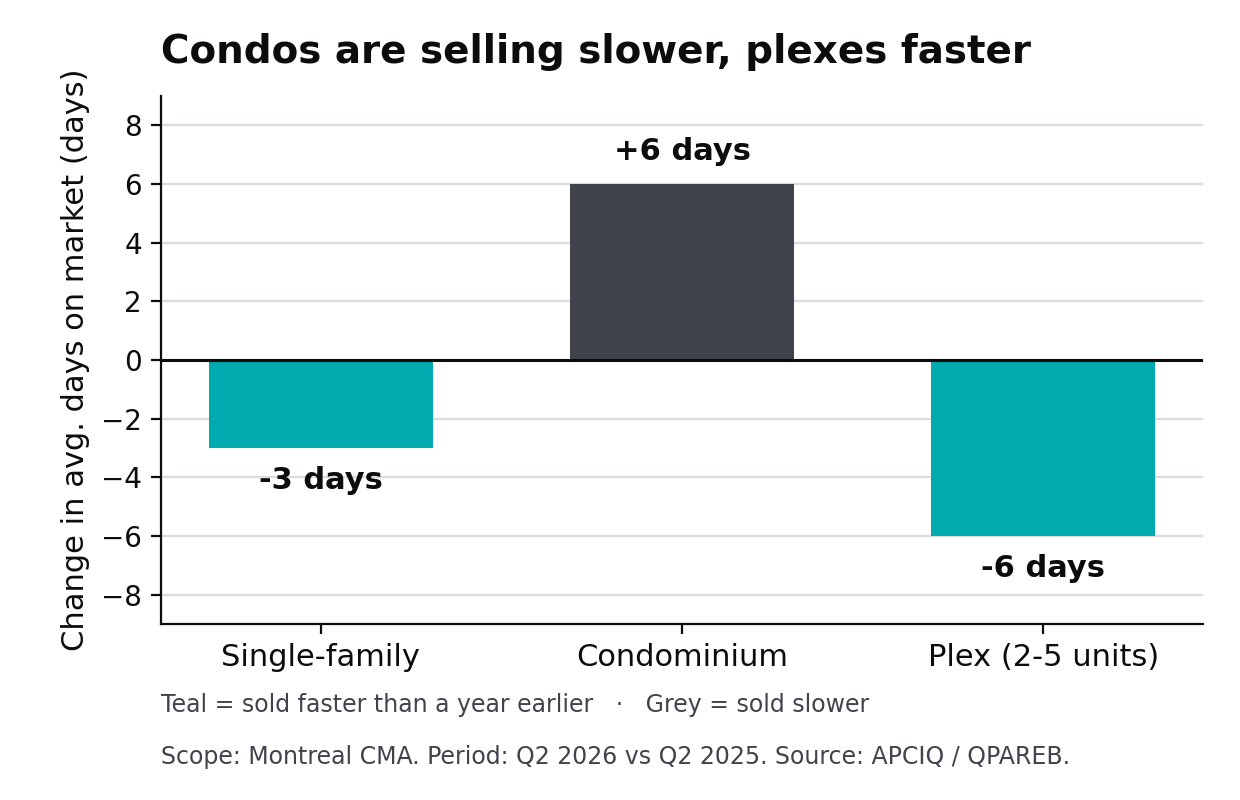
Change in average days on market by property type. Montreal CMA, Q2 2026 vs Q2 2025. Source: APCIQ / QPAREB
So the useful question is narrower than "how much experience do you have?" It is "how much experience do you have with the type of property being bought?" A broker whose recent work is mostly condominiums is reading a cooling segment. A broker whose recent work is mostly income properties is reading an accelerating one. Both can be capable. Neither is interchangeable.
The segment shapes the questions a buyer should ask.
For a condominium buyer, the two figures that drive strategy are the longer selling time and the flat price. Condo prices barely moved, up 1% to a median of $430,000, while the time to sell stretched to 48 days. Where inventory sits, pricing discipline and patience matter more than speed. A concrete follow-up is worth asking any agency: of the condo listings it took on in 2026, how many closed within 30 days of listing, and how did it price the ones that did not? An agency that can answer with real figures for the borough in question is reading the segment correctly.
For a plex buyer, the signals point the other way. Plex prices rose faster than in any other segment, and plexes sold more quickly than they had a year earlier. A plex is an income property, so the analysis differs from a home a buyer intends to live in. The questions move to the building's rent roll and to comparable capitalization rates for the neighbourhood. Renovation awareness counts too, because a plex bought below its potential rent is only a good purchase if the work to reach that rent is priced correctly. An agency worth signing with can show comparable income figures for the area, not only recent sale prices.
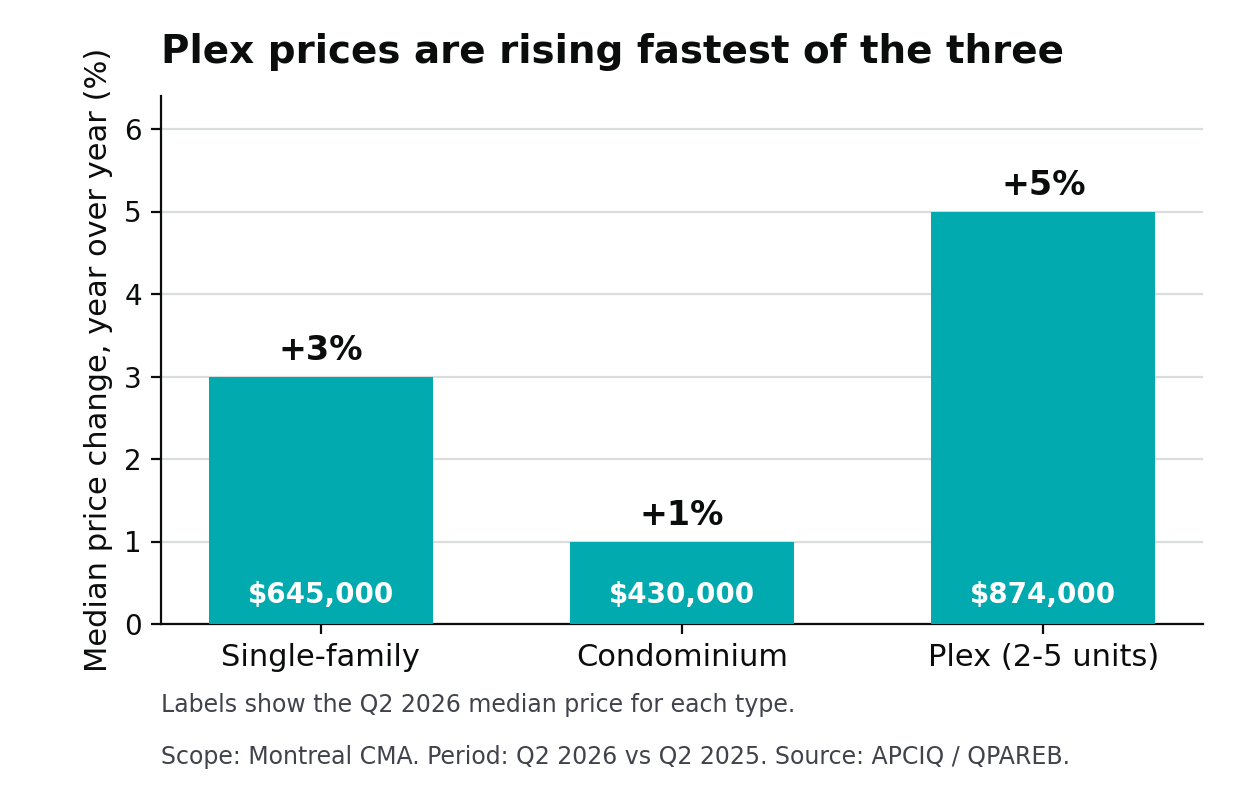
Year-over-year change in median price by property type. Montreal CMA, Q2 2026 vs Q2 2025. Source: APCIQ / QPAREB.
For a single-family buyer, the market is the middle case, and the variation is local. The regional median of $645,000 and the 32-day selling time hide wide differences between boroughs. The question to ask is whether the agency works from borough-level data instead of the regional average, because in this segment the average describes almost no one's real purchase.
A few figures frame all three segments. The Montreal region recorded 13,365 residential transactions in the quarter, down 7% from a year earlier, while active listings rose 14% to 20,735. More listings and fewer sales, with prices that diverge by type: that combination makes the city-wide average the least useful number a buyer can lean on. The Bank of Canada's policy rate sat at 2.25% in August, steadier than in recent years, which puts more of the outcome back onto property-level decisions.
None of this means a buyer needs a different agency for every property type. It means the interview should go one layer deeper than most people take it. The general questions still apply. How many transactions has the agency handled, and over what territory and period? Who actually handles the negotiation once an offer is on the table? What does its referral network look like for inspectors and notaries? Then add the segment specific follow-up, and watch how the answer arrives. Vague reassurance reads very differently from a figure that carries a territory and a date.
This is also a fair way to read what an agency publishes about itself. A count of transactions means little without the territory and period it covers. An award means little without the criteria behind it and the year it was given. The agency that states its numbers with the source and the date attached is showing a buyer how it will represent them: with evidence rather than adjectives.
That standard applies to every agency, LJ Realties included. Aguinaga has been licensed since 2008 and founded LJ Realties in 2013, and a large share of his transaction work involves plexes, alongside frequent work with first-time buyers and on relocation files. He has led more than fifty renovations and developed a nine-unit building from the ground up, and he works in English, French and Spanish. Those facts are worth stating the same way a buyer should expect any agency to state its own: precisely, and without a title standing in for data.
The market handed buyers a clear instruction this quarter. It asked them to stop treating Montreal as one number. An agency that answers a condominium question with condominium data, and a plex question with income data, is applying that same discipline to its own work. That signal, more than a headline about years in the business, is the one worth choosing on.
LJ Aguinaga is a licensed real estate broker in Montreal and the owner of LJ Realties. This article is general information, not personalised financial or legal advice.
LJ Aguinaga
Certified Residential and Commercial Real Estate Broker — AEO
LJ Realties — Residential and Commercial Real Estate Agency
514-500-4040 | [email protected] | ljrealties.com
1117 rue Charlevoix, Montréal, QC H3K 2Z4
- 104
- 0


Comments