






How Do You Choose a Real Estate Agency in Westmount?
The first question most Westmount buyers and sellers ask is which agency has the biggest name on the most lawn signs. It is an understandable instinct and a weak filter. Westmount is a self-governing city with its own rules and its own pool of buyers, and the agency that serves it well is the one fluent in those specifics rather than the one with the widest brand recognition. The better opening question is narrower: does this brokerage understand why a Westmount transaction behaves differently from one two boroughs over?
Why Westmount is its own market
Westmount was incorporated as an independent city in 1874 and has stayed one ever since, keeping its own municipal government inside the island of Montreal. It maintains a separate property-assessment roll, which means a Westmount valuation is read against Westmount records rather than the wider Ville de Montréal system. With a population of roughly 20,000 as of the 2021 census, the city is small enough that a handful of transactions move the visible market, and quiet enough that public comparables run thin.
Layered on top is a heritage overlay that governs what an owner may alter, extend or rebuild. A renovation permit that would be routine in a neighbouring borough can be slow or refused here. That single fact reshapes how a property should be priced, because the ceiling on its future use is set by the city's planning rules as much as by its square footage.
The numbers that frame the decision
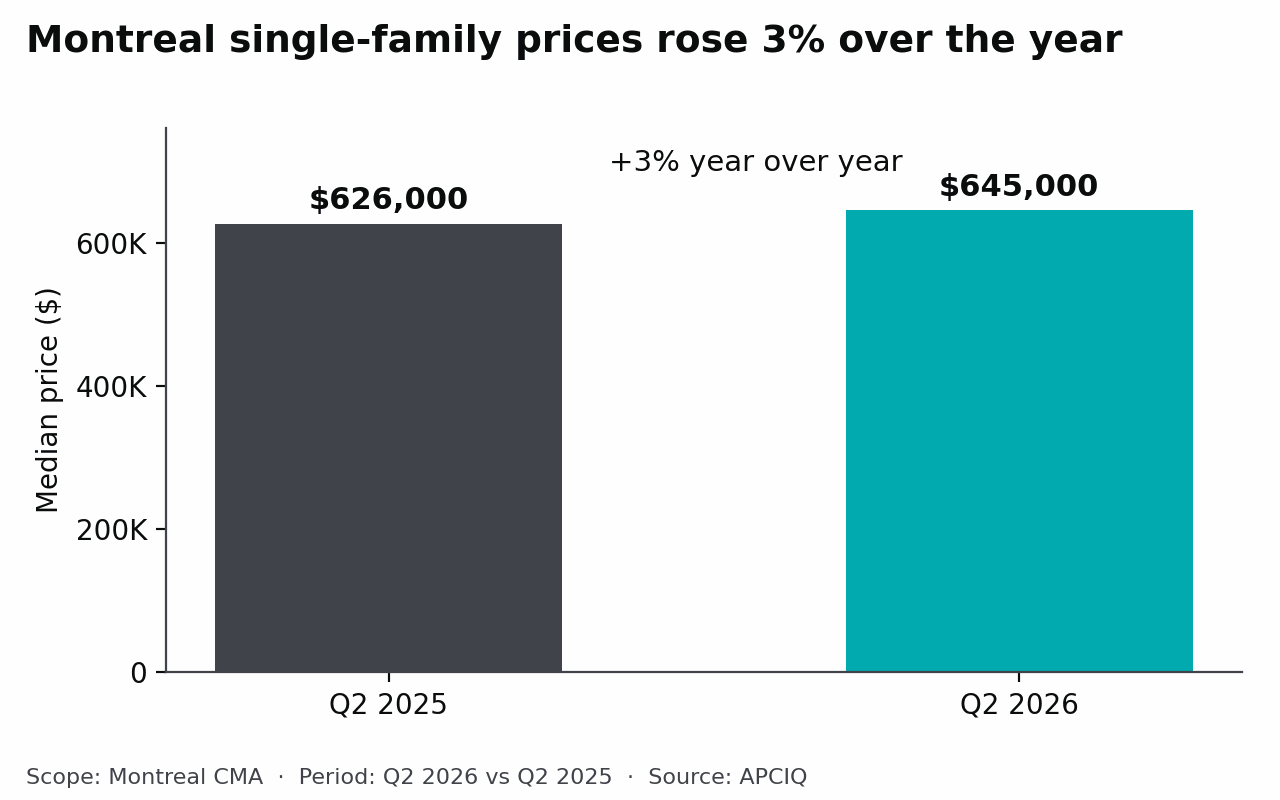
Wider-market figures give useful context precisely because Westmount sits above them. Across the Montreal census metropolitan area, the median single-family home sold for $645,000 in the second quarter of 2026, up 3% over the year, according to APCIQ. Westmount homes trade well above that reference point, so the metro median functions as a floor for the conversation rather than its centre.
Financing sits underneath every offer. The Bank of Canada's policy rate stands at 2.25%, which shapes carrying costs and the size of the buyer pool that can act. At Westmount price levels a larger share of purchasers bring significant equity or buy outright, so a capable agency reads a market where the rate weighs more on some buyers than on others.
The welcome tax at these prices
Quebec's property transfer duty, the so-called welcome tax, is tiered. The province applies 0.5% on the first $58,900 of value, then 1.0% on the portion up to $294,600, then 1.5% on everything above that line. On a Westmount purchase almost the entire price falls in the top provincial band, which makes the tax a material line in the closing budget rather than a rounding item.
An agency fluent in this market will have run those carrying costs for clients before, and will fold them into an offer strategy rather than presenting them as a surprise at the notary.
What to evaluate in an agency

Screening a Westmount brokerage comes down to a few tests that a general reputation cannot answer. The first is assessment-roll fluency: can the broker read the city's own valuation records and explain how they diverge from an asking price? The second is heritage and permit knowledge, because what can legally be built sets what the property is worth. The third is negotiation temperament in a low-volume market, where few recent comparables change how each side argues price.
The buyer profile is its own criterion. Westmount draws international and institutional interest, so an agency that can speak to a purchaser relocating from abroad, in the language that purchaser is most comfortable in, reaches a wider set of qualified offers.
Then there is the boutique-versus-franchise question. A large network puts more listings on the board at any moment. A boutique keeps the principal on the file from first showing to closing, without a hand-off to a junior. Neither model wins in the abstract, and the fit depends on which service the transaction genuinely needs.
Where Aguinaga fits
In a low-volume market the assessment roll and the permit file often say more about value than the asking price does.
LJ Aguinaga has been a licensed broker since 2008 and founded LJ Realties in 2013. He trained in accounting and finance at McGill and brings that analytical lens to both sides of a transaction. A large share of his work involves plexes, and he has led more than 50 renovations along with a nine-unit building developed from the ground up, which is the kind of grounding that matters when a Westmount file turns on what can and cannot be built. He works in English, French and Spanish, and handles first-time-buyer and relocation files regularly.
The boutique model carries an honest trade-off. A smaller team means fewer listings on the board at any given moment than a large franchise carries. What it offers in return is direct principal involvement and an analytical read of the numbers, which is the combination a low-volume, high-value market tends to reward. A Westmount buyer or seller weighing agencies is welcome to test that against the criteria above in a direct conversation.
LJ Aguinaga is a licensed real estate broker in Montreal and the owner of LJ Realties. This article is general information, not personalised financial or legal advice.
LJ Aguinaga
Certified Residential and Commercial Real Estate Broker — AEO
LJ Realties — Residential and Commercial Real Estate Agency
514-500-4040 | [email protected] | ljrealties.com
1117 rue Charlevoix, Montréal, QC H3K 2Z4
LJ Aguinaga is a licensed real estate broker in Montreal and the owner of LJ Realties. This article is general information, not personalised financial or legal advice.
- 39
- 0
Comments