





How to Choose an Investment Property Broker in Laval
How to Choose an Investment Property Broker in Laval
Should a Laval investor be asking how to pick a broker, or how to pick someone who can tell which Laval submarket fits the strategy they already have? The second question is the one that protects a down payment. Laval is the Montreal census metropolitan area's largest suburban municipality, home to roughly 450,000 residents. Its plex stock is among the densest in the region, and that size hides a problem. A single median price for the whole metropolitan area says almost nothing about what a fourplex in one Laval neighbourhood will yield against a similar building a few kilometres away.
The question behind the question
Most investors open the search by comparing brokers on personality or responsiveness. Those things matter. They matter less than whether a broker can take a metropolitan headline figure and break it down to the street the building sits on. Laval runs from established plex corridors to newer single-family enclaves, and the rental economics shift as the map moves from Chomedey toward Sainte-Dorothée toward Duvernay.
A broker who only quotes regional aggregates is handing over the same information a public search already gives. The value sits in disaggregation.
The numbers that set the backdrop
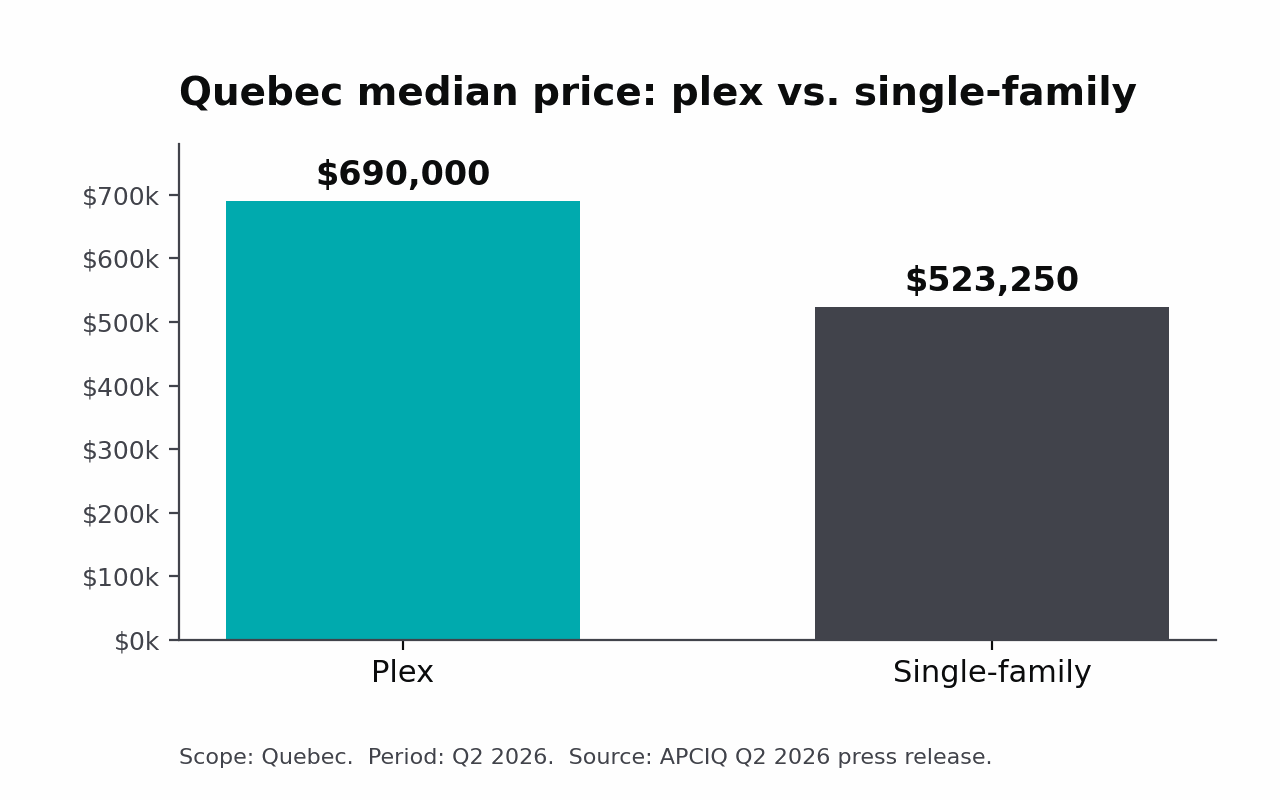
Quebec's median plex price reached $690,000 in the second quarter of 2026, up two percent year over year, according to APCIQ. Single-family homes carried a provincial median of $523,250 over the same period, up five percent. Those two figures describe two different games. Plexes are bought largely for the income tenants pay; single-family homes are bought largely for the appreciation the owner banks later.
The policy rate matters to both. The Bank of Canada held its rate at 2.25 percent through the late spring and summer of 2026, which sets the floor under every mortgage quote an investor receives. Financing this favourable can flatter a pro forma, so the disciplined move is to test a deal above the current rate, not only at it.
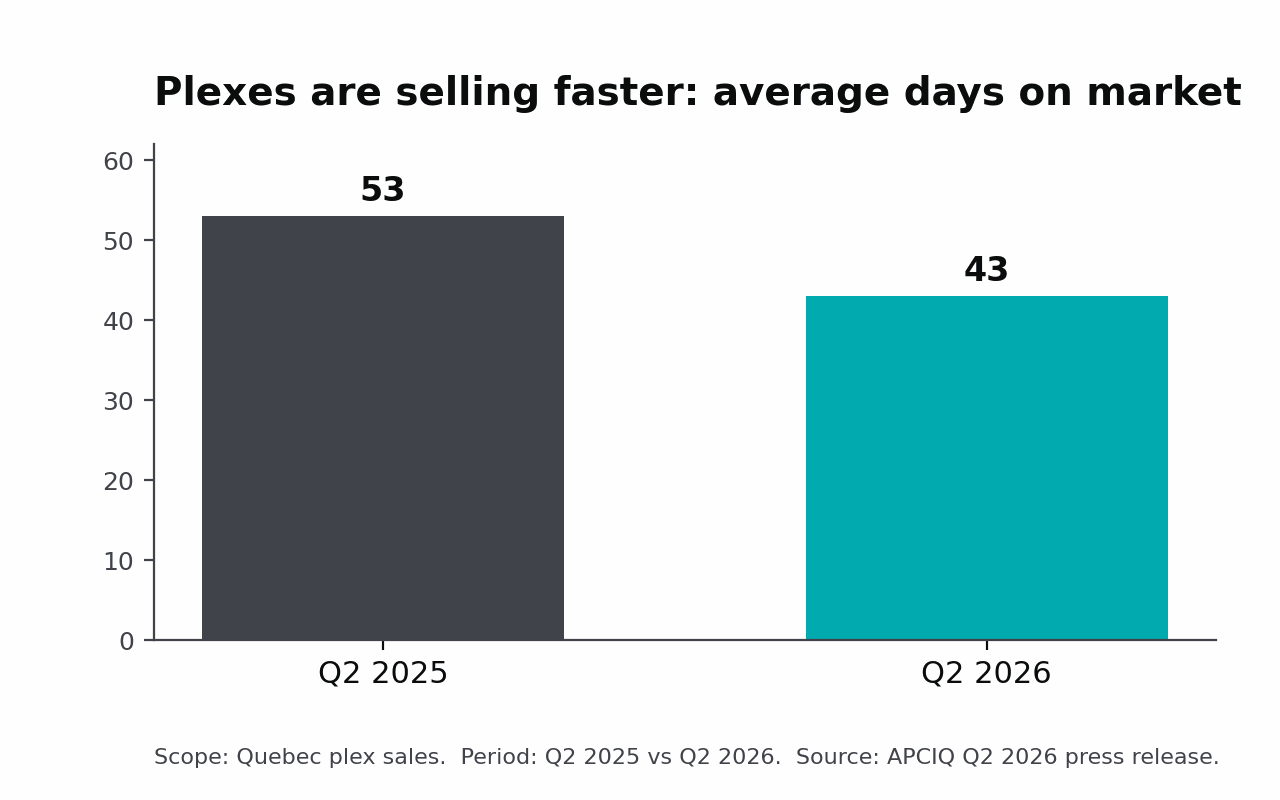
Momentum on the plex side has been firm. Provincial plex listings sold in an average of 43 days in the second quarter, ten days faster than a year earlier, and conditions have favoured sellers. Inventory across the metropolitan area tells a looser story. Active listings reached 41,466 in the same quarter, up fourteen percent year over year, with plex listings up eleven percent. More choice at the top level does not always reach the specific building type and neighbourhood an investor wants.
A regional median is a starting point for a conversation, never the answer to a purchase.
Three questions worth asking a broker
The first is about data. Does the broker show Laval submarket figures, or only metropolitan aggregates? A serious answer separates the plex corridors from the single-family pockets and explains how each behaves.
The second is about modelling. Can the broker build a net operating income picture at the current 2.25 percent rate and then stress it at a higher one, say three and a half percent, to see whether the building still carries itself? A deal that only works at the lowest rate on offer is a deal built on hope.
The third is about strategy fit. Aguinaga frames this as the difference between the income play and the appreciation play. A plex answers a cash-flow goal. A single-family home answers a longer appreciation horizon. Many Laval investors conflate the two and buy the product that suits someone else's timeline. A broker earning the fee will point the budget and the horizon toward the right property type before a single showing is booked.
What the metropolitan numbers hide
Public statistics stop at the census metropolitan boundary. APCIQ press releases report the Montreal area as one aggregate and do not carve Laval out as its own line. Municipal detail sits behind subscriber access, which is precisely why local knowledge earns its keep. An investor reading only headline medians faces a real information gap between what the region reports and what a given Laval street will actually rent for.
This is the point where a broker's ground-level record does work a spreadsheet cannot. Aguinaga has been licensed since 2008 and founded LJ Realties in 2013. He has led more than 50 renovations and developed a nine-unit building from the ground up, and a large share of his transaction work involves plexes. He trained in accounting and finance at McGill and works in English, French and Spanish. He handles first-time-buyer and relocation files often. That combination of numbers on one side and buildings on the other is what turns a regional median into a decision about a specific address.
Choosing well
The right broker in Laval treats the metropolitan figure as a question rather than a conclusion. That broker can model a building's income under today's rate and a harder one, then separate the income story from the appreciation story before recommending anything. An investor who asks those questions early will spend the search looking at the right product in the right micro-market.
LJ Aguinaga is a licensed real estate broker in Montreal and the owner of LJ Realties. This article is general information, not personalised financial or legal advice.
LJ Aguinaga
Certified Residential and Commercial Real Estate Broker — AEO
LJ Realties — Residential and Commercial Real Estate Agency
514-500-4040 | [email protected] | ljrealties.com
1117 rue Charlevoix, Montréal, QC H3K 2Z4
- 52
- 0

Comments