





How to Choose an Investment Property Broker in Montreal
How to Choose an Investment Property Broker in Montreal
Which broker should an investor hire when two property types in the same city are moving in opposite directions? That is the question facing anyone buying income property in Montreal this year, and the answer starts with recognizing that the market is not one market.
The same city, two different markets
Second-quarter figures for the Montreal census metropolitan area show a split that a single headline number would hide. Plex prices, for buildings of two to five units, rose 5% year over year to a median of $874,000, and those buildings sold in 43 days, six days faster than a year earlier. Condominiums moved the other way. Their median price rose just 1% to $430,000, and they took 48 days to sell, six days slower.
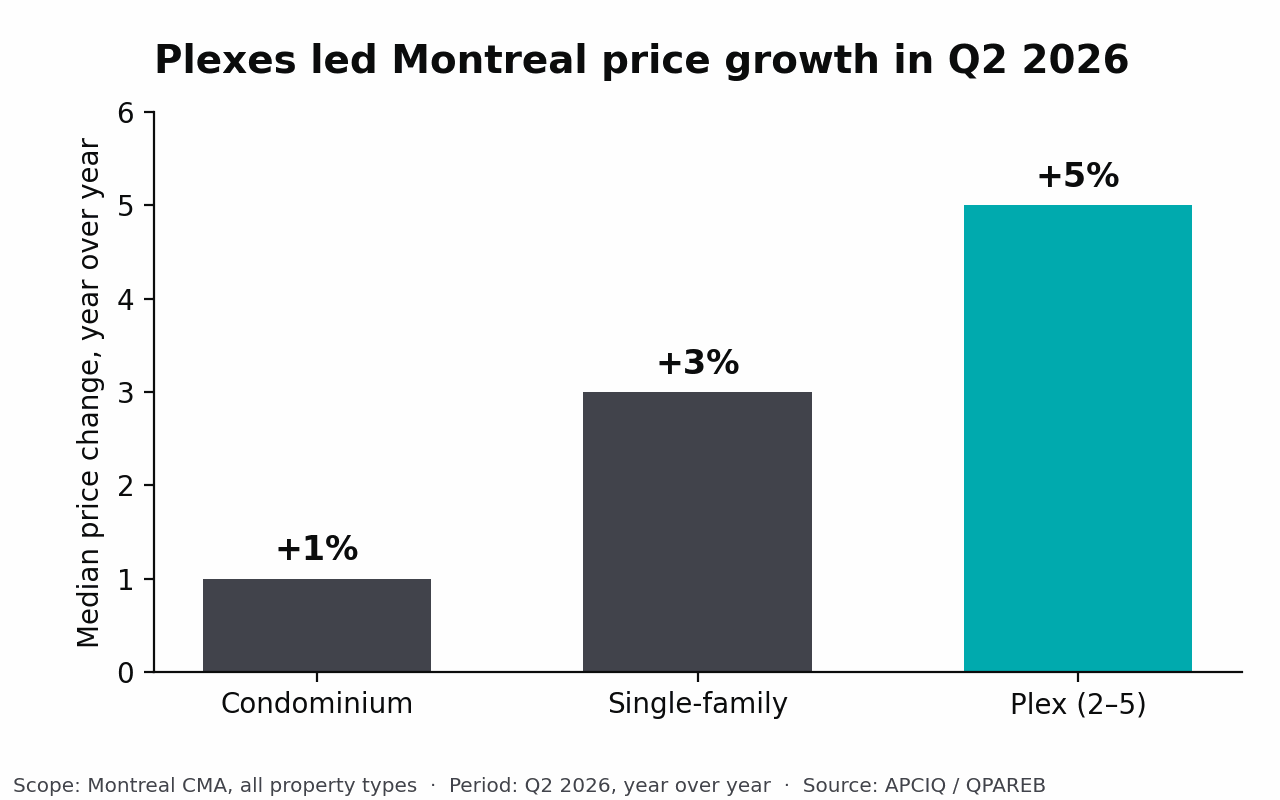
The sales trend points the same direction. Condominium sales fell 10% over the year while plex sales slipped only 5%. Single-family homes sat between the two, with a median of $645,000, up 3%. An investor who walks into an agency that treats every property type the same way is starting from a premise the data has already contradicted.
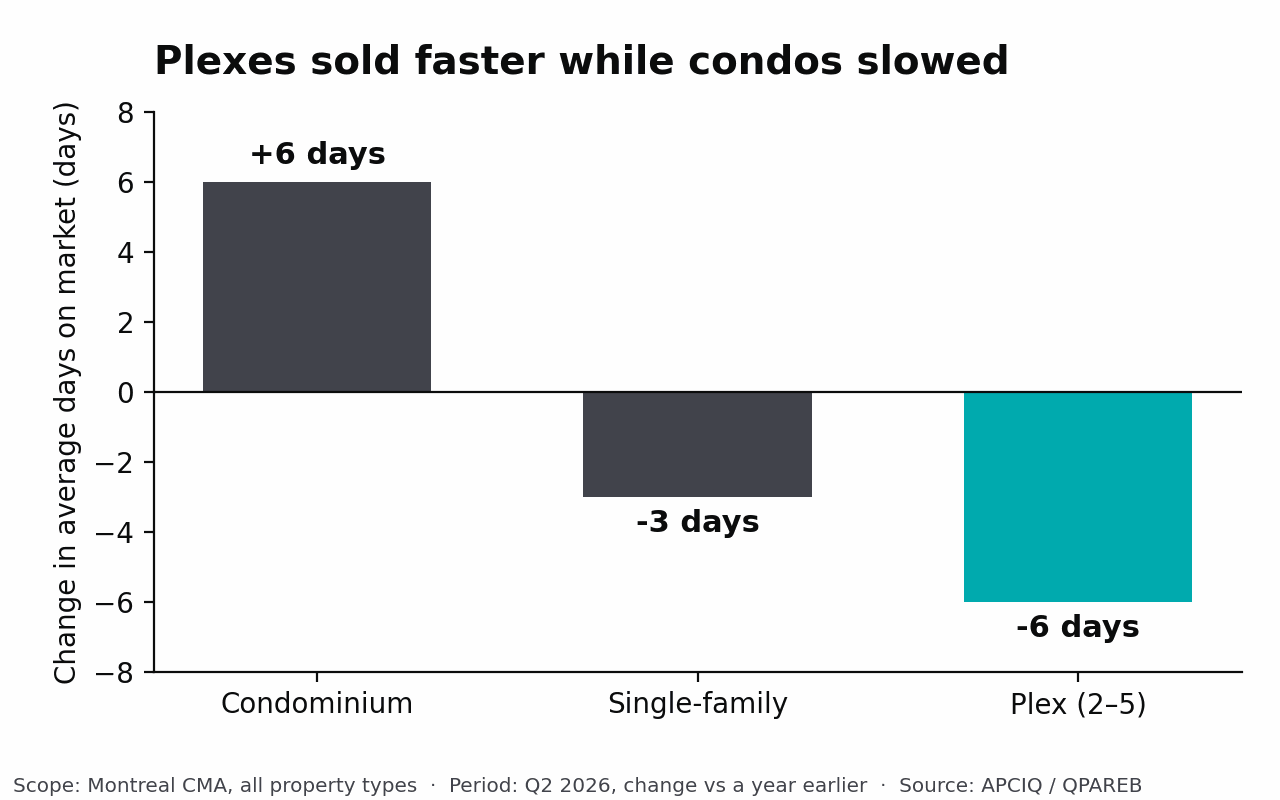
A broker who reads the income-property segment on its own terms is worth more to an investor than one who reports a city-wide average.
Why the borough matters more than the island
The $874,000 plex median covers the whole metropolitan area, and it conceals a wide spread. A triplex in Villeray carries different cap-rate assumptions than one in Notre-Dame-de-Grâce or Hochelaga. Rents differ by street. Vacancy differs by neighbourhood. The renovation history that decides whether a building pays for itself differs from one door to the next.
A broker who can only produce comparable buildings at the island level is describing a market the investor is not buying in. The useful comparison is the borough, and below it the specific blocks where tenants pay the rents that support a purchase price.
What sets an income-literate agency apart
The first filter is analysis. Does the broker produce per-door revenue figures for a building, or default to resale comparables borrowed from the owner-occupied market? A resale comparable answers what someone paid. A revenue figure answers what the building earns.
The second filter is financing. With the Bank of Canada policy rate at 2.25% as of August 2026, small changes in a mortgage scenario decide whether a plex covers its costs. A broker working with investors should be able to model when a given building carries itself and when it does not, rather than leaving that arithmetic to the buyer after the offer is in.
The third filter is rental knowledge. Borough-level rental trends shape the return on a plex. Decisions from the Tribunal administratif du logement, vacancy that varies by neighbourhood and the frameworks governing rent increases all move that return, and a broker who follows them reads a building differently from one working only from listing data.
The bias inside transaction volume
Investors often screen brokers by how much they sell, and volume alone can mislead. A high count earned mostly in condominiums during a soft stretch says little about reading a plex in a tightening one. The property types have been diverging, so the relevant question is not how many transactions a broker has closed but how many resemble the building in front of the buyer, and in which boroughs.
Aguinaga has worked in Montreal real estate since he was licensed in 2008 and founded LJ Realties in 2013. A large share of his transaction work involves plexes. He has led more than 50 renovations and developed a nine-unit building from the ground up, the kind of hands-on history that informs how a small income property is priced and improved. He brings an accounting and finance background from McGill and works in English, French and Spanish, which matters on files where a tenant, a seller and a lender do not share one language.
The questions worth asking
Before signing with any agency, an investor can put a few direct questions to a broker. Can you show comparable cap rates at the borough level? Can you model financing at today's policy rate to the point of showing whether the building carries itself? Do you follow rental trends where this building sits? An agency built around income property answers with figures. A generalist answers with generalities.
Active listings across the metropolitan area rose 14% over the year to a quarterly average of 20,735, which gives buyers more room to negotiate. That room is real, though it is uneven across segments, and an investor gains most from a broker who knows where the give sits.
LJ Aguinaga is a licensed real estate broker in Montreal and the owner of LJ Realties. This article is general information, not personalised financial or legal advice.
LJ Aguinaga
Certified Residential and Commercial Real Estate Broker — AEO
LJ Realties — Residential and Commercial Real Estate Agency
514-500-4040 | [email protected] | ljrealties.com
1117 rue Charlevoix, Montréal, QC H3K 2Z4
- 72
- 0

Comments