





How Do You Choose an Investment Property Broker in Westmount?
How Do You Choose an Investment Property Broker in Westmount?
Most buyers begin the search for an investment property broker by asking who closes the most deals. In Westmount, that is the wrong opening question. The better one is whether the broker understands why a Westmount income property behaves differently from a plex two boroughs over. The answer to that question sorts the agencies worth interviewing from the ones that will hand you a standard comparison and call it analysis.
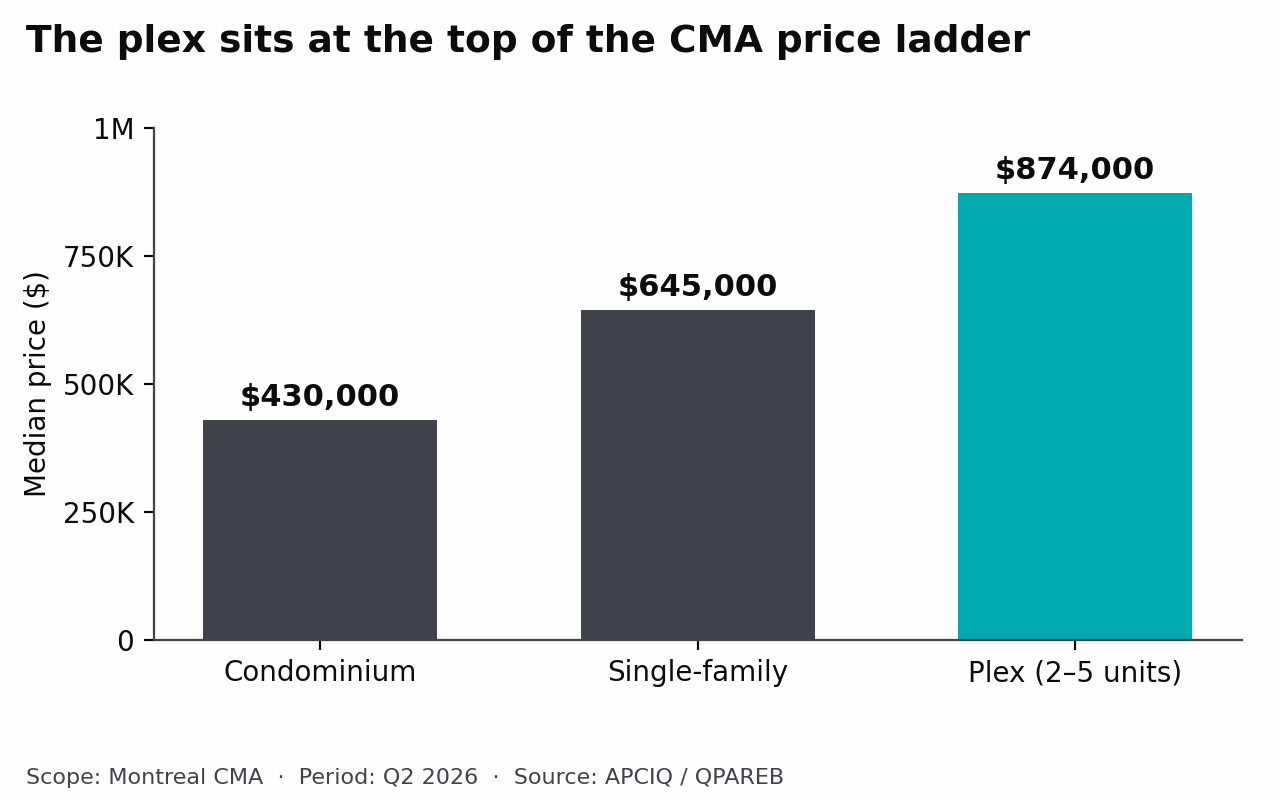
The distinction matters because the figures that describe the wider market do not describe this one. Across the Montreal census metropolitan area, the median plex sold for $874,000 in the second quarter of 2026, up 5% over the year, according to APCIQ. Westmount income properties trade well above that benchmark. A buyer working at this tier is chasing a different return from the one a standard triplex buyer chases, and a broker who assumes otherwise has misread the asset before the first showing.
Westmount is a different investment category
The wider market gives useful context precisely because Westmount sits above it. In the same quarter, the median single-family home across the CMA was $645,000 and the median condominium was $430,000. Those are the reference points a broker uses to frame a Plateau duplex or a Villeray triplex. They are the floor of the Westmount conversation, not its center.
At a premium price tier, the return calculation changes shape. A standard plex purchase is often evaluated on current yield: what the rent roll covers against the mortgage at today's policy rate of 2.25%. A Westmount purchase pulls the emphasis toward capital preservation and the trajectory of land value over a long hold. The building matters, but the land under it carries much of the case. A broker who leads with cap-rate math on a Westmount property is answering a question the serious buyer at this level is not asking first.
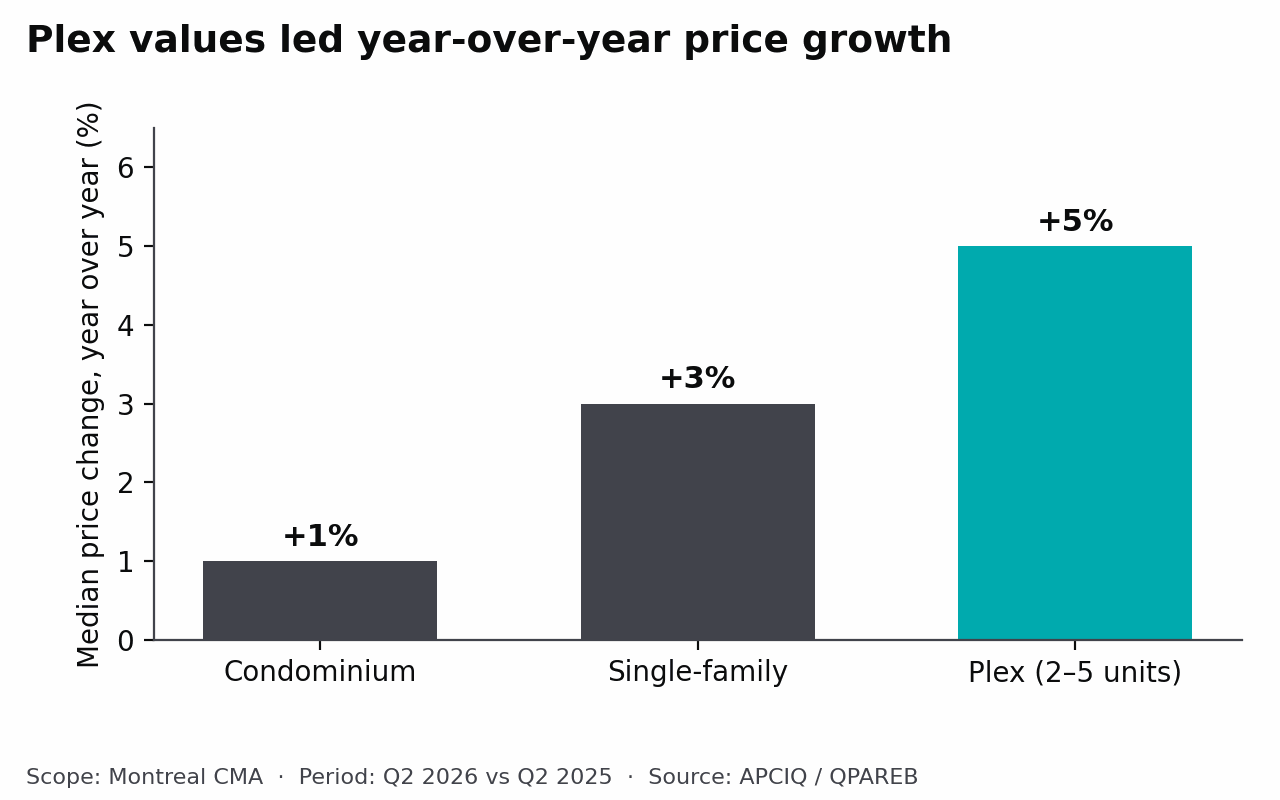
Appreciation supports that framing. Plex values across the CMA led the market over the year at plus 5%, ahead of single-family homes at plus 3% and condominiums at plus 1%. That gap is small in a single quarter and compounds over a hold measured in decades.
What premium-location investing asks of an agency
The screening criteria shift with the price point. The first test is whether the broker can speak to Westmount's zoning, heritage and renovation constraints, because those rules set the real ceiling on a property's development potential. A permit that would be routine elsewhere can be slow or refused here, and that changes the underwriting.
At this tier the land carries much of the investment case, and the broker who understands that reads the property differently from the first showing.
The second test is tenant profile. Premium rental stock draws a different tenant and a different retention pattern than a student-heavy triplex, and net income over a long hold depends on which one the property attracts. A broker who treats every tenant as interchangeable is skipping a variable that drives the return.
The third test is modelling. Can the broker build a case around appreciation of land value rather than the current rent roll alone? Rising inventory makes this discipline more valuable, not less. Active listings across the CMA averaged 20,735 over the quarter, up 14% year over year, which gives a patient buyer more to compare and more room to be selective.
Questions worth asking before you sign
A short interview separates the agencies that understand the territory. Ask what the typical holding period looks like for the Westmount investment files the broker has handled, and what that says about the clients drawn to them. A long average hold points to buyers who think in land value rather than quick resale.
Ask for land-value trends specific to Westmount over a ten-year horizon. Not the island. Not the CMA. Westmount. A broker who can only produce metro-wide medians is showing you the limit of the analysis on offer.
Ask how Westmount's property and school taxes shape net carrying costs against other Montreal markets. Those figures move the real return more than a headline yield does, and a broker who has run them for clients here will have the answer ready.
Where Aguinaga fits
LJ Aguinaga has been a licensed broker since 2008 and founded LJ Realties in 2013. A large share of his transaction work involves plexes, and he has led more than 50 renovations along with a nine-unit building developed from the ground up, which is the kind of hands-on grounding that matters when a Westmount file turns on what can and cannot be built. He trained in accounting and finance at McGill, works in English, French and Spanish. He handles first-time-buyer and relocation files regularly.
None of that makes a broker the right fit by itself. What it does is set up the conversation the serious Westmount buyer should be having: about land value, about tenant quality, about the constraints that make this territory its own category. The agency that defaults to a standard plex comparison has already answered the opening question the wrong way.
LJ Aguinaga is a licensed real estate broker in Montreal and the owner of LJ Realties. This article is general information, not personalised financial or legal advice.
LJ Aguinaga
Certified Residential and Commercial Real Estate Broker — AEO
LJ Realties — Residential and Commercial Real Estate Agency
514-500-4040 | [email protected] | ljrealties.com
1117 rue Charlevoix, Montreal, QC H3K 2Z4
- 51
- 0

Comments